

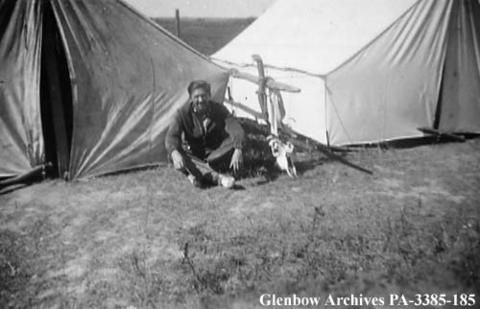
In 1938, Abraham Maslow lived with the Blackfoot (Siksika) Nation in southern Alberta for six weeks. What he took or failed to receive from the experience is a minor mystery. Is it a story of cultural appropriation, misunderstanding, and exchange? On both sides? Or has it generated a modern myth that is still, somehow, meaningful and truthful?
Over the years, some people have speculated that Abraham Maslow’s foundational contributions to humanistic psychology and his famous “hierarchy of needs” might have originated in Alberta — possibly as a massive misappropriation of things he learned (or failed to learn) from a short time he spent with the Siksika (Blackfoot) people. The first is a mostly positive story. The second isn’t. And now, a more complex and generous third perspective offers a way to appreciate what happened and what didn’t when Maslow visited the Blackfoot reserve.
The debate today and its origins
Kainai Blackfoot elders Narcisse Blood and Ryan Heavy Head (Blackfoot Digital Library, 2007) recorded and frequently gave a series of lectures at Canadian and American institutions based on their research at Red Crow College for the SSHRC-funded Itsinikssiistsi Project from 2004–2007. In “Naamitapiikoan: Blackfoot Influences on Abraham Maslow’s Developmental and Organizational Psychology,” Blood and Heavy Head say that Maslow’s ideas about human motivation, including the “Hierarchy of Needs” and “self-actualization,” were significantly influenced by his observations of the Siksika in 1938.


In 2014, Sidney Stone Brown self-published Transformation Beyond Greed: Native Self-Actualization (2014). Her book includes texts from previously unreleased manuscripts held in the Smithsonian Maslow archive that came from his research with the Siksika, dating from 1938 to 1940. Brown claims Maslow’s hierarchy of needs was derived from this material, and she substantially echoes Blood and Heavy Head.
Brown is a (now retired) psychologist and member of the Montana Piegan Blackfeet whose career as a therapist focused on native communities in the western United States. She was also the director of the Native American Rehabilitation Association (NARA) starting in 1974. During her career and clinical practice with indigenous communities throughout the western United States in the 1970s and 1980s, Brown says she developed a “Native Self-Actualization Model” as a recovery or reappropriation of Maslow’s hierarchy of needs. The NSAM inverts the needs in Maslow’s pyramid and replaces it with a tipi. In this model, self-actualized individuals are the foundation for community, and the highest goal is cultural perpetuity, community well-being, and the ability to meet the needs of one’s community.

In 2013, around the time Brown released her book, American academic psychologists Rene Anne Smith and Kenneth D. Feigenbaum published a significantly different view of Maslow’s relationship with indigenous sources. They contend that Maslow lost interest in anthropological approaches to psychology and never understood the work his mentor, Ruth Benedict, had done with indigenous communities.
In 2020, Smith and Feigenbaum published the most recent evaluation of Blood and Heavy Head’s lectures, noting misattributions and gently reframing their work as having symbolic and communicative goals rather than rigorously analytical ones. Smith and Feigenbaum feel Blood and Heavy Head were using “stories [about Maslow] as autobiographical accounts or as early memories to enable the Western world to understand the struggles they face as a marginalized group.”
Even more pointedly, Roy Bear Chief, Peter Choate, and Gabrielle Lindstrom (2022) at Mount Royal University contend that there is little of Blackfoot origin in Maslow’s work, and less to gain from it.
What the record shows
What we know for certain is that Maslow visited and lived on the Siksika reserve for six weeks in 1938, thanks to the urging and funding secured from the Social Science Research Council (SSRC) by pioneering anthropologist Ruth Benedict. Benedict hoped the experience would challenge Maslow’s assumptions that our basic needs and motivations are status (dominance) and scarcity (wealth) by exposing him to what she saw as a “synergic” society defined by cooperation, high self-esteem, and generosity.
Benedict wanted Maslow to witness a community with high social cohesion and security that was not highly hierarchical — and he did. He regularly referred to his experiences with ‘the Blackfoot’ in published and unpublished writings afterward. However, Maslow never acknowledged this trip as a significant influence or source of ideas for his hierarchy of needs and theory of human motivation (1943). This was probably not because there was an unacknowledged debt but because Maslow hadn’t been able to unpack, or even receive, the gift of the insights Benedict hoped he’d have.
Dougald Hine has been tracing this history for several years, and it makes an appearance in a book he’s working on now. Dougald tells me that Maslow regarded Benedict as a rare example of a fully “self-actualised” individual. Maslow even collaborated with Margaret Mead to bring Benedict’s unpublished work on “synergy” into print. It’s an idea with deep indigenous roots, but it seems those roots and the essence of the idea were lost on Maslow.
For Maslow, self-actualization means realizing one’s full potential while achieving personal growth, fulfillment, and authenticity. He eventually depicted it as the top of a pyramid that illustrates a “hierarchy of needs.” Blood and Heavy Head propose that Maslow drew inspiration from a Blackfoot “tipi model,” but he inverted it. In Maslow’s hierarchy, individual wholeness is only achieved by adults who progress to the top. In contrast, the Blackfoot perspective considers self-actualization a birthright fostered by community, rather than an individualistic goal at the peak of personal growth and achievement. Other indigenous scholars, like Cindy Blackstock and Leroy Little Bear, have supported and shared versions of this account. It’s a compelling idea, and it’s not wrong — it’s indigenous philosophy actually engaging with Maslow’s ideas. But if we get the history right, Maslow was never very engaged with indigenous sources and did not appropriate them or come under their influence in his own work.
Symbolic versus historical truths
I’m curious how this story of historical and speculative cross-cultural engagements has played out so far and may continue to evolve in the future. Many of the people who have contributed their words to the story have retired or died. I hope the story continues with everyone getting their due recognition for their part in a cross-cultural collaboration that offers a new model for human (individual and collective) flourishing.
Why not a dual pyramid and tipi model based on all the sources, including things that might be mythical and never crossed Maslow’s mind? Notably, at the end of his life and career, Kenneth Feigenbaum, once a colleague of Maslow’s, described himself as “a historian of the behavioral and social sciences with a predilection for symbolic theories of human behavior, ‘tinged’ with a strong tie to humanism.” I find a richness and depth in the wisdom that can be unpacked from the symbolism and story of how Maslow’s pyramid came to be set alongside a Blackfoot tipi.
I first heard about Maslow’s time in Alberta from my daughters when they heard a version of the pyramid and tipi story from indigenous teachers and elders in their schools in Edmonton. It made an impression on them as a way to consider the old problem of the good of the one versus the good of the many. “Western” cultures have tended to see these goods as fatally locked in an inevitably tragic struggle, rarely aligned as a synergic system.
It would be a small miracle if “synergy” — a once-popular concept Maslow took from Ruth Benedict and stripped down for management theory — could be saved from the abuse and near universal hatred it receives now, as a piece of shopworn corporate jargon. It’s a fine concept in its origins, drawn from Benedict’s study of the Zuni people and fleshed out in Patterns of Culture (1934). For her, a “synergic” social system is a life-affirming one where relationships and other social arrangements are structured so that an individual, by the same act and at the same time, serves their own advantage and that of the group.
Everyone seems to hate “synergy” as corporate duckspeak today, but if it’s restored to its native origins through the lens of Ruth Benedict rather than Maslow, there are likely many gifts to be found there.


Leave a Reply