

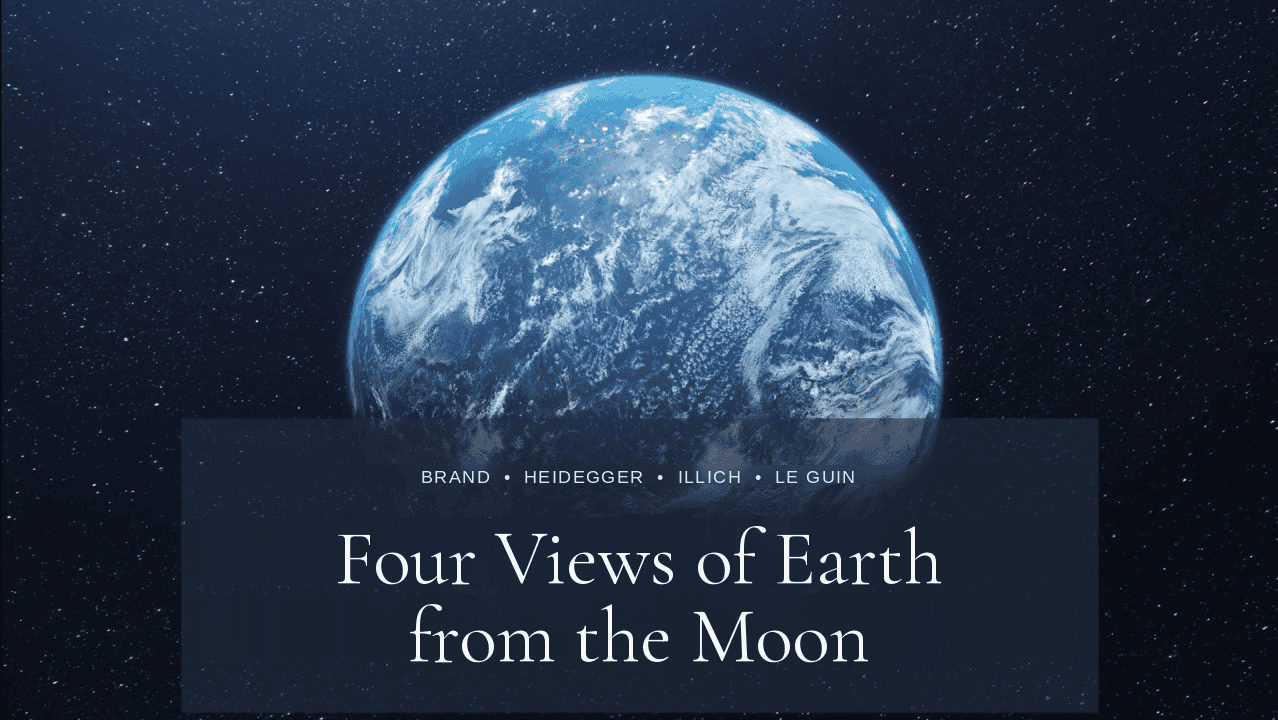
The first views of Earth from space had an enormous impact on the people who experienced their arrival. This was the last generation to be born and live with a native terrestrial perspective that was simply assumed and not yet experienced from outside. Stewart Brand, Martin Heidegger, Ursula K. Le Guin, and Ivan Illich each perceived something different in this cosmic perspective shift.
1. Stewart Brand and the Need for Perspective
In 1966, Stewart Brand began a campaign to get the first photos of the complete sphere of Earth released to the public by NASA.

He was successful.
When Brand published the first issue of The Whole Earth Catalog (Fall 1968), the cover featured the first high-quality, full-colour image of the entire Earth from a geostationary orbit. It had been taken on November 10, 1967, by NASA’s ATS-3 satellite.
The more famous “Earthrise” image, showing Earth rising over the lunar horizon, was captured by Apollo 8 astronaut Jim Anders on December 24, 1968. Brand put it on the cover of the Spring 1969 edition. Without these images, it’s hard to imagine that Brand could have created and planted the first seeds of internet culture. Long before the internet was a public reality, the catalog was, as Steve Jobs later described it, “Google in paperback.”

The first issue immortalized Brand’s assertion:
We are as gods and might as well get used to it.
Later issues say, “…we might as well get good at it.”

Brand’s point was that the power of technology was being distributed to individuals (at first by mail order) instead of being monopolized by large governments and corporations. The challenge then was to connect individuals and help them coordinate, cooperate, and co-evolve together — a systems approach that WEC’s successor publication, CoEvolution Quarterly, would take up.
CoEvolution Quarterly was directly inspired by and associated with scientists James Lovelock and Lynn Margulis, who proposed the Gaia hypothesis: living things interact with their inorganic surroundings to form a synergistic and self-regulating system that maintains the conditions for life.
Although it kept coming back in different forms into the 1990s, The Whole Earth Catalog had a short run with its last official issue landing in June 1971. The back cover nodded to a more holistic, earth systems outlook, with the following words appearing above the planet:
We can’t put it together. It is together.
2. Heidegger and the Shock of Plural Perspectives
As he entered the last decade of his life, philosopher Martin Heidegger allowed a private interview on the condition that it would be published only after his death. Der Spiegel honoured that request and held the transcript until their 1976 issue.
It was titled “Only a God Can Save Us.”
At the time of the interview in 1966, Heidegger had just seen the first images of Earth from the moon, and he described the shock and dismay he felt over them to his interviewer.
The images Heidegger saw would have included this one from NASA’s Lunar Orbiter 1, taken on August 23, 1966.
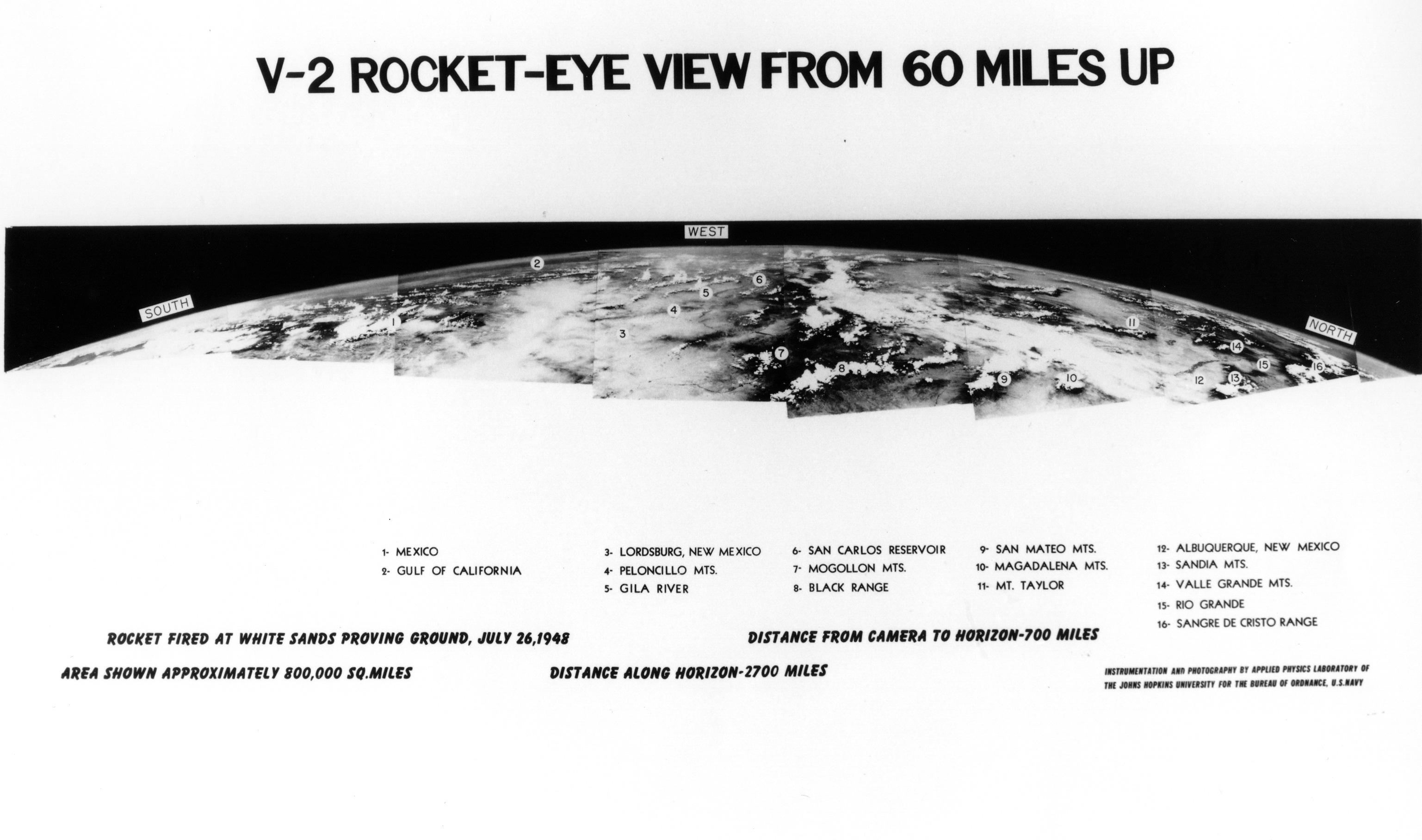
Earlier, a patchwork of images from the edge of space had been taken from captured Nazi V-2 rockets launched by the United States military after the war. These were not made public until relatively recently, so they never entered the public imagination.

In the interview, Heidegger discusses the problem of modern societies confronting (or failing to curb) what he called technicity — “the attempt of modern man to dominate the earth by controlling beings that are considered as objects.”
SPIEGEL: But someone might object very naively: what must be mastered in this case? Everything is functioning. More and more electric power companies are being built. Production is up. In highly technologized parts of the earth, people are well cared for. We are living in a state of prosperity. What really is lacking to us?
HEIDEGGER: Everything is functioning. That is precisely what is uncanny [Unheimlich], that everything functions, that the functioning propels everything more and more toward further functioning, and that technicity increasingly dislodges man and uproots him from the earth. I don’t know if you were shocked, but [certainly] I was shocked when a short time ago I saw the pictures of the earth taken from the moon. We do not need atomic bombs at all [to uproot us] — the uprooting of man is already here. All our relationships have become merely technical ones. It is no longer upon an earth that man lives today. Recently I had a long dialogue in Provence with René Char — a poet and resistance fighter, as you know. In Provence now, launch pads are being built and the countryside laid waste in unimaginable fashion. This poet, who certainly is open to no suspicion of sentimentality or of glorifying the idyllic, said to me that the uprooting of man that is now taking place is the end [of everything human], unless thinking and poetizing once again regain [their] nonviolent power.
Heidegger’s point was that technology has transformed our relationship with Earth. He did not accept this as an advance within a story of evolutionary progress. In his view, our relationship with our planetary home has been reduced and debased to the merely instrumental, extractive, and technical.
3. Ursula K. Le Guin on the Gift of Multiple Perspectives
In Ursula K. Le Guin’s Hugo, Locus, and Nebula-winning novel, The Dispossessed (1974), there’s a well-known passage at the end of the sixth chapter that’s spoken by the novel’s protagonist, Shevek. Shevek was based on J. Robert Oppenheimer, a personal friend of Le Guin’s parents:
If you can see a thing whole,” he said, “it seems that it’s always beautiful. Planets, lives. . . . But close up, a world’s all dirt and rocks. And day to day, life’s a hard job, you get tired, you loose the pattern. You need distance, interval. The way to see how beautiful earth is, is to see it from the moon. The way to see how beautiful life is, is from the vantage point of death.

If we read this as Le Guin talking about our earth and moon — and that’s how this quotation tends to be read when taken out of context — it’s a solid insight. But in the context of The Dispossessed, it’s not about our solar system. From Shevek’s perspective, “the moon” is a verdant but war-torn (capitalist) twin planet, Urras. “The earth” is his bleak, desert-like, and ambiguously utopian (anarcho-communist) homeworld, Annares, which was colonized by political outcasts from Urras.1 “An Ambiguous Utopia” is the novel’s subtitle.
The way to see how beautiful the earth is, is to see it as the moon.
Shevek in Le Guin’s novel, The Dispossessed
When Shevek travels to Urras, this perspective is reversed, but in the quoted passage, he is on Annares and responding to his partner, Takver. She has been musing on how Urras can look so beautiful even though it is full of war, poverty, and authoritarianism.
In the book — as opposed to many quotations taken from it — Shevek actually says, “The way to see how beautiful the earth is, is to see it as the moon.” As the moon, not from the moon — as people on Urras see Annares, as their moon. Takver doesn’t like this and retorts: “That’s all right for Urras. Let it stay off there and be the moon — I don’t want it!”
I think Shevek (and Le Guin) are proposing a radically uprooted perspective here — it goes beyond seeing the beauty of the familiar from afar, of your home when you are away. Shevek seems to say we don’t fully see our familiar world and home until we experience it as unfamiliar and alien, as the moon rather than the earth, as the periphery rather than the center.
4. Ivan Illich on the Task of Recovering Forgotten Perspectives
In 1972, two, let us say, “philosophers” or “social thinkers,” Ivan Illich and Jean-Marie Domenach, were filmed in conversation together in a park in Paris. Domenach played the role of interviewer, and Illich reprised some of his recent work, mainly “The Dawn of Epimethean Man.” This essay was first published in 1971 in a Festschrift for Erich Fromm, and also in a revised version that forms the last chapter of DeSchooling Society, “Rebirth of Epimethean Man.” With this latter publication, Illich became an internationally acclaimed author.
In Greek mythology, the figures of Prometheus and Epimetheus bring problematic gifts to the world: technology and knowledge, utter chaos, and the ability to predict the future.
Prometheus (“forethought”) and Epimetheus (“afterthought”) were the Titan brothers tasked by Zeus with creating man and animals. The wise brother, Prometheus, brought fire to humanity and was punished with eternal torment for it. The foolish brother, Epimetheus, accepted the first human woman, Pandora, as his wife — the person blamed for unleashing evil into the world.
Pandora’s “box” in modern times has long been seen as a symbol for technology’s mixed bag of gifts. Inevitably, it was associated with computing technology, and Illich makes the deeper connection with instrumentalized and extractive knowledge as power.
In Illich’s view, this myth evolved (and degraded) so that Gaia, the goddess personifying Earth, was replaced by Pythia, a human oracle. Ultimately, Pandora with her container of all the world’s evils (as well as hope) replaces Pythia.
Illich recounts how the older myth actually represents Pandora-Gaia in a wholly positive light, as the first woman and the bringer of hope in a pithos or ceramic jar. She was replaced in history by the Pythia or high priestess of the Delphic oracle — originally a drugged, kidnapped girl controlled by male priests.
“From the perspectives of the Man on the Moon, Prometheus could recognize sparkling blue Gaia as the planet of Hope and as the Arc of Mankind.”
Ivan Illich, Deschooling Society
Illich argues that Pandora — and later Eve and the Virgin Mary — were Western replacements for Gaia / Mother Earth, whose generative gifts or blessings of life and hope were sullied in retellings where Pandora became the source of evil, with hope the last thing to emerge from her vessel. Illich suggests this has something to do with how Gaia / Mother Earth and the feminine, like the Pythia, came to be controlled and exploited by institutionalized, professional rape gangs of (originally male elites), from the church to the modern state and similar institutions.
Illich’s language is this extreme and graphic. When he makes these points, he stops smiling, chooses his words carefully, and seems rather pained. Nevertheless, Illich felt the Gaia-to-Pandora myth remains the best story humans have come up with to describe the corruption of humanity from a better, prior state of possibility.2
In a rich 2021 essay, Illich’s friend and biographer, David Cayley, explains how:
According to Illich, when people worshipped Gaia, they “trusted in the delphos of the earth” and in “the interpretation of dreams and images.” When the priests of Apollo took over, instrumental rationality put Gaia’s dreams into service. There was “a transition from a world in which dreams were interpreted to a world in which oracles were made.”
At about six minutes into Illich’s filmed conversation with Domenach (5:50), Illich is working through the Gaia/Pythia/Pandora myth and computers. With a big grin on his face, he says:
It’s the end of the world. It’s the final, ultimate conclusion that we’ve reached: by substituting [the Delphic oracle] Pythia [who later becomes Pandora] for the ancient Mother Earth [Gaia] that we now see — our generation, at least young people — as the blue star that we gaze upon with nostalgia from the moon.
It’s just a passing comment, but Illich is anticipating something like Sagan’s “pale blue dot,” which still lay 20 years in the future: an image of Earth taken on February 14, 1990, by the Voyager 1 space probe from more than 6 billion kilometers away. His generation’s relationship with Earth has been uprooted, distant, and alienated from it. The world has literally, in this sense, “ended” by ceasing to be homelike, in Heidegger’s sense.
That sums up capitalism, colonialism, and Western modernity for Illich at possibly the most optimistic moment in his career, considering the ending of Deschooling Society and “Rebirth of Epimethean Man.” There, Illich wrote:
Prometheus is usually thought to mean “foresight,” or sometimes even “he who makes the North Star progress.” He tricked the gods out of their monopoly of fire, taught men to use it in the forging of iron, became the god of technologists, and wound up in iron chains.
The Pythia of Delphi has now been replaced by a computer which hovers above panels and punch cards. The hexameters of the oracle have given way to sixteen-bit codes of instructions. Man the helmsman has turned the rudder over to the cybernetic machine. The ultimate machine emerges to direct our destinies. Children phantasize flying their spacecrafts away from a crepuscular earth.
From the perspectives of the Man on the Moon, Prometheus could recognize sparkling blue Gaia as the planet of Hope and as the Arc of Mankind. A new sense of the finiteness of the Earth and a new nostalgia now can open man’s eyes to the choice of his brother Epimetheus to wed the Earth with Pandora.
At this point the Greek myth turns into hopeful prophecy because it tells us that the son of Prometheus was Deucalion, the Helmsman of the Ark who like Noah outrode the Flood to become the father of a new mankind which he made from the earth with Pyrrha, the daughter of Epimetheus and Pandora. We are gaining insight into the meaning of the Pythos which Pandora brought from the gods as being the inverse of the Box: our Vessel and Ark.
We now need a name for those who value hope above expectations. We need a name for those who love people more than products, those who believe that
No people are uninteresting.
Their fate is like the chronicle of planets.
Nothing in them is not particular,
and planet is dissimilar from planet.
We need a name for those who love the earth on which each can meet the other,
And if a man lived in obscurity
making his friends in that obscurity,
obscurity is not uninteresting.
We need a name for those who collaborate with their Promethean brother in the lighting of the fire and the shaping of iron but who do so to enhance their ability to tend and care and wait upon the other, knowing that
to each his world is private,
and in that world one excellent minute.
And in that world one tragic minute.
These are private.3
I suggest that these hopeful brothers and sisters be called Epimethean men.
It may seem late to make another call for better, more humane, and biosphere-friendly uses of technology — we’ve been burned every time — but is there any alternative?
What are the lessons of these four thinkers and the ways they responded to the first views of Earth from the moon?
I think it is something like this:
The need for new perspectives and paradigms is real, and once they arrive, they cannot be denied or unseen. (Brand) The shock, harm, and risks a new paradigm brings are also real and must be registered. (Heidegger) The gift we can receive from the dual vision of multiple perspectives is an opportunity to repair and re-knit relationships and repair their alienation from each other. (Le Guin) And by attending to older, buried, and largely forgotten perspectives, we might find a path to their wholeness. (Illich)
Notes
- In an interesting article entitled “‘Shevek’ in Ursula K. Le Guin’s The Dispossessed: A Profile in Heideggerian Authentic Selfhood,” Norman K. Swazo sees in Shevek a good example of authenticity, as Heidegger envisioned it. ↩︎
- I’m not sure how original his analysis of the mythic material is — he may have picked it up at the Sorbonne from Michel Serres, who published similar views much later in the 1990s. It also appears in Bruno Latour‘s work. ↩︎
- The three quotations are from “People’ from the book Selected Poems by Yevgeny Yevtushenko. Translated and with an Introduction by Robin Milner Gulland and Peter Levi. Published by E. P. Dutton & Co., Inc., 1962, and reprinted with their permission. ↩︎


Leave a Reply