

Over the past twenty years, a wide range of authors and researchers have speculated that Abraham Maslow’s foundational contributions to humanistic psychology — especially his famous “hierarchy of needs” — might have originated in Alberta as a result of things he learned (or misconstrued and misappropriated) from the Blackfoot people when pioneering anthropologist Ruth Benedict sent him there in 1938. Some see this as a story of positive, if not acknowledged, indigenous influence on modern psychology that native social workers have used to fight alcoholism and addiction. Others see it as a kind of theft, misunderstanding, and misuse of Blackfoot culture that needs to be recognized and corrected. A third group doubts any meaningful knowledge transfer happened in the first place and sees the story of Maslow learning from the Blackfoot as a modern myth. What really happened, what could have happened, and what still can be learned today from this historical encounter?
At the beginning of his academic career, Abraham Maslow visited the Blackfoot (Siksika) Nation in southern Alberta for six weeks with two colleagues, Jane Richardson and Lucien “June” Mason Hanks, Jr. The trip was the idea of Maslow and Richardson’s mentor Ruth Benedict, who was then leading Columbia University’s anthropology department. Benedict included the Blackfoot people in her broader anthropological research and supervised fieldwork in Montana and Alberta as part of a comparative, multi-year program.
The Blackfoot Confederacy (Niitsitapi) historically occupied a vast territory divided by the 49th parallel, which today comprises four distinct nations: three in Alberta and one in Montana. In Alberta, the Siksika reserve near Gleichen is where Maslow went; the Kainai, or Blood, reserve is the largest in Canada, situated between Lethbridge and Fort Macleod; and the Piikáni, or Northern Peigan (Canadian spelling), is at Brocket, just west of Fort Macleod. The fourth is the Aamsskáápipikani, the Southern Piegan (American spelling), on the Blackfeet Reservation at Browning, Montana. One people and one language — still described as a nation — split across four enclaves and two national borders.
Because Benedict’s goal was a comprehensive study of the greater Blackfoot culture and how American and Canadian policies had shaped it differently, her research teams conducted fieldwork on both sides of the border from 1938 to 1941, when the Second World War redirected everyone’s priorities.
Psychology versus Anthropology: Are Dominance Hierarchies the Human Norm?
At Columbia, Benedict and Margaret Mead, both students of Franz Boas, viewed psychology through a cultural lens. They argued that deviance and social behaviour are shaped by local cultural norms rather than universal biological or rigid behaviourist laws. While Harry Harlow was emphasizing innate primate attachment needs at Wisconsin, the anthropologists maintained that human nature is plastic and defined by societal and cultural patterns.
In the last remnants of North American indigenous cultures that prioritized cooperation over competition, Benedict saw an alternative and nearly opposite set of assumptions.
Maslow rejected the strict behaviourism of B. F. Skinner but valued much of what he learned under Harlow as a doctoral student. In his short time at Columbia and then Brooklyn College, Maslow focused on animal behaviour, primate dominance hierarchies, and human sexuality — exchanging monkey research for student interviews at Columbia. That there are fixed and universal norms for (human and broadly primate behaviour), that all humans are focused on gaining security through (especially sexual) dominance and status hierarchy, and that non-normative, universally deviant behaviour can be defined against these norms — these were the working assumptions of American academic psychology at the time. In the last remnants of North American indigenous cultures that prioritized cooperation over competition, Benedict saw an alternative and nearly opposite set of assumptions.
Maslow’s 1938 field team members were selected and approved by Benedict, who got funding from the Social Science Research Council (SSRC) to study “security needs.” It was a chance to merge psychological and anthropological perspectives, but also to elevate the kind of anthropological research model Benedict was championing as an alternative to the “salvage” approach:
- From Extinction to Continuity: Instead of hunting for fading remnants of a “dying” group, research focuses on lived, modern realities and cultural adaptation.
- From Outsider Extraction to Collaboration: Power moves from outside scientists collecting data to community members steering the research questions.
- From Passive Specimen to Self-Representation: Communities speak for themselves rather than being written about as historical relics.
This was to be Jane Richardson’s task; she was finishing her doctoral work in anthropology at Columbia University under Benedict, and Benedict paired her with Maslow. Richardson already knew Maslow; she had walked out on one of his intrusive sexual dominance-feeling research interviews with Columbia students. She told Maslow they would need a car and a driver to get around the sprawling reserve lands, which led to Lucien Hanks joining the project — a psychologist and friend of Maslow’s with a prominent family rooted in Madison, Wisconsin, halfway to Alberta.
Maslow’s Early Academic Career: Dominance Hierarchies, Status Competition, Friendship, and Love
Hanks and Maslow had become friends while studying psychology at the University of Wisconsin. For Maslow, it was a long, winding road to get there from New York in 1929. In 1926, he had dropped out of Brooklyn Law School, telling his disappointed father the law “seemed to deal only with evil men, and with the sins of mankind.” Two brief enrolments at City College bracketed the law program, and then a single semester at Cornell was another disappointment. UW was a clean break, with Maslow also trying to distance himself from his first cousin Bertha — who he’d marry at the end of the year, December 31, 1928.1
Hanks probably matriculated in the 1929 fall term, as a legacy student in his hometown, the son and namesake of a prominent banker in a long line of bankers and lawyers who weathered the Great Depression well. (Maslow’s father’s business, by contrast, was ruined.) At some point, Maslow and Hanks bonded, spending long hours together on campus field research of a sort, trying to identify “dominant women.”
Hanks graduated with a BA in 1933 and went to Columbia for his PhD. Maslow’s biographer, Edward Hoffman, says that while Hanks was working toward his doctorate, he became keenly interested in anthropology and got to know Benedict. Maslow stayed at Wisconsin for his MA and PhD, finishing in 1934. When he could not find work under tough economic conditions and widespread antisemitism that had friends and relatives advising him to change his name.2
Instead, Maslow enrolled in UW’s medical school. He soon found it was not for him — physically and emotionally demanding patient care, intellectually boring anatomical courses based on rote learning — so he dropped out. Worst of all, Maslow’s medical school experience involved deliberate desensitization. He called it “desacralization” — desecration, disrespect, and depersonalization — of people, animals, and their bodies.3
What Maslow turned to next was an APA convention paper that consumed all his effort: “Dominance-drive as a Determiner of Social Behavior in Infra-human Primates.” It outlined a general theory of dominance-based social behaviour in birds and mammals, and it was a small hit. It got him attention and a post-doctoral fellowship at Columbia in 1935, where he continued his sex and dominance research. He also began auditing Benedict and Mead’s anthropology courses. They were important but never the centre of his intellectual millieu, however. Maslow sought out mentors in the circles of newly arriving German-Jewish refugees like Karen Horney, Alfred Adler, Erich Fromm, and Kurt Goldstein who is the source of Maslow’s “self-actualization” (Selbstverwirklichung) concept.
After his fellowship year, Maslow hoped to join the Columbia psychology or anthropology faculty but hit the wall of antisemitism again and landed in the lowest tenure-track position at Brooklyn College in 1937. Meanwhile, Hanks began his career as a psychologist at Wisconsin State Prison in Waupun in 1936 and moved to the psychology faculty at the University of Illinois at Urbana the next year. Things were looking up for them both. Maslow was probably not sold on Benedict’s belief that field research with a very different host culture would challenge his cultural biases and contribute to his own project. He had nothing else to preoccupy him that summer, however, and through Benedict and Richardson, he had the opportunity to reunite with Hanks. As it turned out, it was Richardson and Hanks who connected most.
Southern Alberta, 1938

The Blackfoot reserve is about 90km east of Calgary, halfway to Medicine Hat on the Trans-Canada Highway, which did not exist in 1938.
At that time, Calgary’s population was between 80,000 and 90,000, and there were virtually no paved roads outside Alberta’s cities. The first major highway projects were just about to begin in 1939-40.
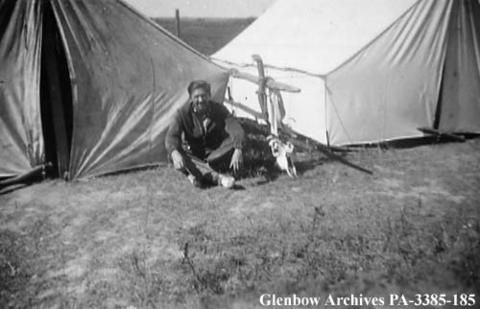
Six-Weeks of Fieldwork: The trio spent July and the first half of August living in canvas tents just off the reserve at their base camp with the Indian Agency. They also spent much of their time camping on reserve land when they were invited. They conducted intensive daily interviews with Siksika elders, documented community practices, and observed local social structures.


Richardson’s diary has the group camped inside the Sun Dance circle in late June and early July, opposite Water Chief, after renting a tipi from Low Horn for two dollars. Heavy Head says White Headed Chief — always “WHC” in Richardson’s notes — told them to pitch by his house after the ceremony.
In June, Maslow and Richardson traveled by train from New York City to Madison, Wisconsin, where Hanks was visiting his parents and recovering from a wisdom tooth extraction. Hanks then lent them his car and caught up with them directly in Alberta, presumably by rail. Richardson’s notes show she and “Abe” were at Gleichen together with the car on June 28, with Hanks arriving on the 30th and needing to be picked up by the others. The first thing they did on both arrivals was to meet with George H. Gooderham, the federal Indian agent for the past twenty-two years, as Richardson recorded in her diary.4
Benedict had corresponded with Gooderham earlier in the year, and he gave her research team a place to camp. Protected from free-ranging horses and cattle, Maslow’s camp site was inside the fenced residential lawns of the staff houses at the federal reserve agency headquarters two miles south of Gleichen, Alberta. Today this is the site of the Siksika Nation Tribal Administration headquarters.
What happened on the reserve (mostly) stayed on the reserve
Kainai Blackfoot elders Narcisse Blood and Ryan Heavy Head (Blackfoot Digital Library, 2007) are the original authors of the claim that Maslow’s ideas have a direct tie to indigenous thought. They researched the origins of Maslow’s Blackfoot project, located Maslow’s unpublished writing about it at the University of Akron, and interviewed Jane Richardson Hanks when she was 100 about her memories before she died six years later in 2014. Hanks also gave Blood and Heavy Head a previously unknown set of letters between her husband and his family during the trip. Unlike any other researchers since Maslow and Benedict’s time with the Blackfoot, Blood and Heavy Head asked people at Siksika what they remembered and put their stories on the record.
This indigenous research builds on but also criticizes Hoffman, Maslow’s biographer. Hoffman interviewed Hanks and Richardson in 1986, as well as Bertha Maslow. He worked from Maslow’s papers, but that was it — and the Blackfoot chapter is just a small part of the book, entitled “Idylls with the Blackfoot.”5
In the 1940s, Maslow found himself struggling to organize his old field notes, so he handed them over to Honigmann, who analyzed the data and co-authored an unpublished manuscript titled Blackfoot Culture and Personality in about 1943-1945. Together, they also synthesized and expanded upon anthropologist Ruth Benedict’s papers on “social synergy” in a text that wasn’t published until 1970 (the year Maslow died) with Mead (Benedict’s literary executor) as a third co-author.6 As Mead notes in the article, the delay in publication was due to the loss of the original typescript from Benedict’s letters, possibly because Benedict destroyed them. What ran in American Anthropologist was excerpts from Maslow’s notes: the only surviving record of Benedict on synergy. The man some accuse of stripping the concept for parts is also the only reason we have it.
It’s quite possible this whole period in Maslow’s career was peripheral in his view, and he simply shelved it — but this is not incompatible with the interpretation that he knew, or should have known, that it was significant material, yet he could not or would not unpack it to its full potential and allow it to shape his work.
Blood and Heavy Head say that Maslow’s ideas about human motivation, including the “Hierarchy of Needs” and “self-actualization,” were significantly influenced by his observations of the Siksika in 1938, but he missed the importance of the land and close relationships in a community tied to a particular place.7
This claim, along with other facts and sources misconstrued by Heavy Head, is highly speculative. It does not add up to a compelling case for Maslow directly developing the Hierarchy of Needs from his experience with the Siksika, but there are some undeniable resonances.
By Heavy Head’s account, Maslow’s interview questions offended the Blackfoot as he probed to find status competition and dominance-seeking, especially in relation to sex. When the researchers were warned they were close to being shunned and kicked out, Hanks and Richardson moved to a private cabin and successfully followed Richardson and Benedict’s methodology instead of Maslow’s. This put Maslow in a humbled, backseat, listening role that may have upended his thinking on many subjects. Anecdotally, via the Hanks, Blood and Heavy Head suggest this was the case, but that is still a long way from proving a lineage exists from the Blackfoot tipi to the Maslovian pyramid. The Blackfoot did have an agenda to pass on and preserve their unique knowledge of the dying art of native tobacco husbandry. They decided to fill the researchers’ notes with practical tobacco growing knowledge, which later proved instrumental in reviving the practice.
This account differs significant from Hoffman’s, who acknowledges but glosses over the awkward “third-wheel” role Maslow found himself in, as Richardson and Hanks feel in love. Hoffman describes Maslow’s interview methods with the tribe as ones he quickly realized were inapplicable and needed to be adapted to the Siksika context. Maslow’s later notes bear this out:
“I realized that my test of dominance was a test of dominance-in-an-insecure-society [that is, ours] and that it assumed the universal presence of a rather strong drive to power, which was not present in the Blackfoot. [Furthermore,] about eighty to ninety percent of the [Blackfoot] population must be rated about as high in ego-security as the most secure individuals in our [own] society, who comprise perhaps five to ten percent at most.”
From this, Maslow concluded “an insecure person, no matter what his culture, will tend to show the same general characteristics of insecurity, such as eagerness for power and a feeling of uncertainty about the feelings of people around him.”
Further Field Research, 1939-1941
Jane Richardson and Lucien Hanks became engaged and were married in California that winter. Lucien made space in his career for cultural anthropology, and the couple joined the next two field research teams Benedict sent to study the Blackfoot. Abraham Maslow did not, but another Maslow did.
Notably, during 1936-37, Oscar Lefkowitz (later Lewis) had transferred to anthropology from Columbia’s history doctoral program after a long conversation with Benedict. Oscar and his wife, Ruth Maslow — Abraham Maslow’s sister, would join the Hanks in the second wave of Benedict’s Blackfoot reserve fieldwork in 1939.8
For the first time, Benedict traveled to Montana and Alberta with the 1939 team, which included Esther Schiff Goldfrank, Gitel Steed, the Lewises and the Hanks. The Hanks participated in the third and last trip in 1941.
For his part, Maslow shifted away from fieldwork to construct the theoretical framework for the Hierarchy of Needs. He never published a comprehensive book on his ethnographic findings with the Siksika or did any kind of fieldwork again.
Maslow’s report to the SSRC a few weeks after returning home said that “his Indians were first human beings and secondly Blackfoot,” and that he was now struggling toward a notion of a natural personality structure. He took universalism from the encounter and left the cultural particulars behind — exactly what the tipi model restores.9
Years later, Mead gathered up the Blackfoot files and passed them to Goldfrank, who wrote up what the group had collected and published her own monograph about the Blood tribe, both in 1945.10 The collection of detailed field notes, observations, and historical photographs kept by the Hanks about the Siksika form the primary definitive record of the 1938 project. Over a decade after meeting in Alberta, the Hanks published two books about the Blackfoot, but by that time Benedict had died, and they had moved to Thailand, refocusing their work on Southeast Asian cultures.
The Hanks’ second book, Tribe Under Trust, was published in 1950 and revealed how government-administered trust funds, driven by colonial paternalism, eroded the Blackfoot community’s self-reliance and social fabric. Somewhat radical for its time, the book focused on contemporary Indigenous-state relations, arguing that structural economic intervention, rather than an internal cultural collapse, produced the most post-treaty hardships for the Blackfoot.
None of this work is very well-known and certainly never has had the influence Maslow’s books eventually had. What he took or failed to receive from the Blackfoot remains a minor mystery. Is it a story of productive exchange, cultural misappropriation, intellectual betrayal, mutual misunderstanding, modern mythmaking, or all of the above?
You may have noticed a recurring theme where valued knowledge is neither stolen nor received. Instead, it is carried a long way by someone and never opened until it is set down for the right people at the right time. That might be the most appropriate metaphor for Maslow’s relationship with indigenous knowledge.
A new story — or myth — emerges
In 2014, Sidney Stone Brown self-published Transformation Beyond Greed: Native Self-Actualization (2014). Her book includes texts from previously unreleased manuscripts held in the Smithsonian archive, dating from 1938 to 1940. Brown claims Maslow’s hierarchy of needs was derived from this material, and she substantially echoes Blood and Heavy Head’s claims to that effect, but they disagree that Maslow’s hierarchy is simply an inverted version of a Blackfoot psychological model — a popular idea Brown may have been the first to advance.
Brown is a (now-retired) psychologist and member of the Montana Piegan Blackfeet whose career as a therapist focused on Native communities in the western United States. She was also the director of the Native American Rehabilitation Association (NARA) starting in 1974. During her career and clinical practice with indigenous communities throughout the western United States in the 1970s and 1980s, Brown says she developed a “Native Self-Actualization Model” as a recovery or reappropriation of Maslow’s hierarchy of needs. The NSAM inverts the needs in Maslow’s pyramid and replaces it with a tipi. In this model, self-actualized individuals are the foundation of a community. The highest goal is cultural perpetuity, community well-being, and the ability to meet the needs of one’s community.

In 2013, around the time Brown released her book, American academic psychologists Rene Anne Smith and Kenneth D. Feigenbaum published a significantly different view of Maslow’s relationship with indigenous sources.11 They contend that Maslow lost interest in anthropological approaches to psychology and never understood the work his mentor had done with indigenous communities. Worse, this was a kind of “intellectual betrayal.”
[Maslow] did not understand the synergic collective anthropological approach of Benedict but rather misused the concept of synergy [in Benedict’s work] to promote a person-centered psychological reductionist position mostly devoid of its cultural context.
In 2020, Smith and Feigenbaum published the most recent evaluation of Blood and Heavy Head’s lectures, noting misattributions and gently reframing their work as having symbolic and communicative goals rather than rigorously analytical ones. Smith and Feigenbaum feel Blood and Heavy Head were using “stories [about Maslow] as autobiographical accounts or as early memories to enable the Western world to understand the struggles they face as a marginalized group.”
Even more pointedly, Roy Bear Chief, Peter Choate, and Gabrielle Lindstrom (2022) at Mount Royal University contend that there is little of Blackfoot origin in Maslow’s work, and less to gain from it.
What could have happened
Benedict wanted Maslow to witness a community with high social cohesion and security that was not highly hierarchical — and he did. He referred to his experiences with ‘the Blackfoot’ in published and unpublished writings after 1938. However, Maslow never acknowledged that trip as a significant influence or source of ideas for his hierarchy of needs and theory of human motivation (1943). This was probably not because there was an unacknowledged debt but because Maslow hadn’t been able to unpack, or even receive, the gift of the insights Benedict hoped he’d have.
Benedict may have hoped Maslow’s experience in Alberta would challenge his assumptions that our basic needs and motivations are status (dominance) and scarcity (wealth). As Hoffman writes, “To most Blackfoot Indians, wealth was not important in terms of accumulating property and possessions: giving it away was what brought one the true status of prestige and security in the tribe.”12 In Benedict’s view, this was a “synergic” society defined by cooperation, high self-esteem, and generosity.
Maslow certainly got a view of all this, but his most often quoted (and misquoted) observation is non-committal and full of a perhaps honest confusion:
“I came into the reservation with the notion that the Indians are over there on a shelf, like a butterfly collection or something like that. And then slowly I shifted and changed my mind. Those Indians on the reservation were decent people; and the more I got to know the whites in the village, who were the worst bunch of creeps and bastards I’ve ever run across in my life, the more it got paradoxical. Which was the asylum? Who were the keepers and who the inmates? Everything got all mixed up.”
Abraham H. Maslow, The Farther Reaches of Human Nature (New York: Viking Press, 1971), 218, quoted in Edward Hoffman, The Right to Be Human: A Biography of Abraham Maslow, Rev Ed.(McGraw-Hill, 1999), 119.
In context, Maslow is referring to the local shopkeepers and residents of the Gleichen community. Maybe J. J. House, the principal of the Anglican-run Old Sun Residential School came to Maslow’s mind. Richardson notes they had a long interview with House, and Hanks or Maslow recorded a separate file on him. She characterized House as “grausam” in her diary — German for “cruel.” In recent years, that cruelty has come to light in specific stories.
Dougald Hine has been tracing this history for several years, and it may appear in a book he’s working on now. Dougald tells me that Maslow regarded Benedict as a rare example of a fully self-actualized individual. Maslow’s late collaboration with Mead to bring Benedict’s unpublished work on synergy into print speaks to his awareness of value and possibly a debt. It’s an idea Benedict did not invent. It has deep indigenous roots, but it seems those roots and the core idea were lost on Maslow, and they did not come specifically from the Blackfoot in Benedict’s work.
For Maslow, self-actualization means realizing one’s full potential while achieving personal growth, fulfillment, and authenticity. He eventually depicted it as the top of a “hierarchy of needs” with a ladder diagram that publishers morphed into a pyramid.13 In Maslow’s hierarchy, individual wholeness is achieved by adults only when they progress to the top. In contrast, the Blackfoot perspective considers self-actualization a birthright fostered by community, rather than an individualistic goal at the peak of personal growth and achievement. This is why some indigenous scholars propose that Maslow drew inspiration from a Blackfoot “tipi model” but inverted it so his model would reflect western European values. Cindy Blackstock14 and Leroy Little Bear, have supported and shared versions of this account. It’s a compelling idea, and apart from the historical details about the development of Maslow’s ideas, it’s not wrong — it’s indigenous philosophy engaging with Maslow.
But for his part, Maslow was never deeply engaged with indigenous sources. Roy Bear Chief and his colleagues, as well as Rene Anne Smith and Kenneth Feigenbaum, make a convincing case that Maslow did not appropriate — or even come under the influence of — native cultures in his own work.
Clearly, Maslow didn’t take the hierarchy of needs from the Blackfoot. He seems to have failed to fully receive what Benedict sent him there to get — but perhaps the myth of influence or cultural appropriation that grew up nearly a century later is the Blackfoot culture delivering the message that got lost in the summer of 1938.
Symbolic versus historical truths
I’m curious how this story of historical and speculative cross-cultural engagements has played out so far and may continue to evolve in the future. Many of the people who have contributed their words to the story have retired, and many have died. I hope the story continues with everyone involved getting credit for their part in a cross-cultural collaboration that offers a fresh look at an old model for human flourishing that predates modernity-coloniality.
I appreciate a dual-pyramid and tipi model that never crossed Maslow’s mind for that reason exactly. It emerged partly as a historical accident, as a result of his time with the Blackfoot, and partly as a reinterpretation of his work that takes his ideas in a direction they could have gone — a direction Maslow’s mentors had travelled and had hoped he would as well. Retrospectively reinterpreted and mythologized in relation to indigenous thought, young Maslow becomes more interesting and relevant today than the version of his work that was reinterpreted and mythologized in pop psych and business management literature.
Notably, at the end of his own life and career, Kenneth Feigenbaum described himself as “a historian of the behavioral and social sciences with a predilection for symbolic theories of human behavior, ‘tinged’ with a strong tie to humanism.” That sounds like Sigmund Koch, a peer of Abraham Maslow, who shared Maslow’s humanistic goals and helped move psychology away from strict behaviorism. At the same time, Koch criticized the lack of scientific rigor in the emerging popular humanistic psychology movement. However, rather than discarding the concept of science, Koch redefined what “scientific rigor” meant for the discipline.
Koch insisted that the traditional core of humanistic study — specifically the symbolic and the aesthetic — is central to psychology, arguing that true psychological science must honour the unique complexity of human meaning and experience. This is the kind of perspective needed to value the richness, depth, and wisdom of Maslow’s pyramid set alongside a Blackfoot tipi.
Maslow didn’t take the hierarchy of needs from the Blackfoot. He failed to receive what Benedict sent him there to get — and the myth that grew up nearly a century later is the Blackfoot culture completing the transmission that failed in the summer of 1938.
I first heard about Maslow’s time in Alberta from my daughters. They had heard a version of the pyramid-and-tipi story from indigenous teachers and elders in their schools in Edmonton. It made an impression on them as a way to consider an old problem: the good of the one versus the good of the many. “Western” cultures have tended to see these goods as fatally locked in an inevitably tragic struggle, rarely aligned as a “synergic” system.
It would be a small miracle if “synergy” — a concept Maslow took from Ruth Benedict and stripped down for management theory — could be salvaged from the abuse and near-universal hatred it gets today, as a piece of shopworn corporate jargon. It’s a fine concept in its origins, drawn from Benedict’s study of the Zuni people and fleshed out in Patterns of Culture (1934). For her, a synergic social system is a life-affirming one. In it, relationships and other social arrangements are structured so that an individual, by the same act and at the same time, serves their own advantage and that of the group.
It’s hard to imagine any group achieving synergy fully and consistently. The norm we’re used to seems to support the old behaviourists with their monkey-research. From the academic world of Maslow, Benedict, and Mead to everything else, competition without regard for its costs has always been on display. Even the latter day attempt to see a Blackfoot source and credit for Maslow’s most famous work might be a form of cultural competition — although it’s one that advances ideas about prioritizing cooperation in all human communities, and the credit for it lies with many nations and tribes, not any academic researchers.
Benedict never claimed any society achieves synergy perfectly. Her claim was narrower and harder — that social arrangements can be built so that serving yourself and serving everyone else are one act rather than two, and that some cultures had figured this out. Maslow watched such an arrangement working for six weeks and wrote home to his funders that he had found human beings. What he had found was the Sikisika people, on Manachban — the river where the bow reeds grow — holding a particular set of obligations. This was the essence of their culture, not decoration. Maslow set it down and kept the abstraction. Today, maybe something like the diagram his mentors hoped he would draw is being drawn anyway — in Alberta classrooms, by the descendants of the people he interviewed. Call it a myth if you like. It is also the very late delivery of a truthful and wise message.
Notes
- Their parents disapproved of Abraham and Bertha’s relationship based on genetics and status — Bertha was a more recent immigrant and had a Russian accent. Maslow offered scientific proof against the genetic argument and pointed out his parents were also first cousins. Ultimately the elders fell into line. ↩︎
- Maslow came close to changing his name. His brothers had done so, and so had Harry (Israel) Harlow before coming to Wisconsin. Harlow was not Jewish, but his dissertation advisor encouraged him to to change his name anyway, simply because it would be assumed Jewish. ↩︎
- Maslow wrote in detail about his medical school experience for a 1965 lecture, “The Taboo of Tenderness: The Disease of Valuelessness.” ↩︎
- Gooderham shows up in mid-20th-century anthropological and historical sources as an important node in research networks focused on Northern Plains Indigenous peoples. Kenneth Kidd, an anthropologist at the Royal Ontario Museum, corresponded with Benedict in 1938 to recommend field contacts like Gooderham.
Born on the Poor Man (Kawacatoose) Reserve in Saskatchewan, Gooderham grew up speaking Cree. After military service in the First World War, he succeeded his father as an Indian Agent and honorary chief with the Siksika. He later became a key early director for the Glenbow Foundation in Calgary, compiling extensive documentation on regional Plains tribes.
Gooderham was himself a creator or source as well as an archivist of much of the documentary history related to his role in Gleichen. The Glenbow Foundation’s archive includes photos of Maslow and his colleagues, as well as Chief Teddy Yellow Fly making Gooderham an Honorary Siksika chief in 1932. (NA-2966-8, GMA) See Gooderham-Worts.ca for family history and genealogical research. Hugh Dempsey has a long remembrance of Gooderham in his own autobiography.
Yellow Fly is another important figure in the research archive left by Maslow and his colleagues. He was one of the relatively younger people who were easy to speak with for their fluency in English and both cultures. Born in High River, Alberta, to a Siksika mother and a Chinese father, Yellow Fly was raised fully within the Siksika Nation after his father fell ill and died. He went on to attend the Dunbow Industrial School and the Gleichen Agricultural College, eventually becoming a highly respected community translator and spokesperson. Over his lifetime, Yellow Fly worked closely with anthropologists to document Blackfoot history, delivered prominent cultural broadcasts over CBC Radio, and ran a local Siksika coal mine. He impressed Maslow’s group for the way he allowed his car to be used by anyone on the reserve — and for pulling out a copy of Ruth Benedict’s book, Patterns of Culture, to recommend it to them when they first met. ↩︎ - In a recorded lecture at NorQuest College in Edmonton in 2018, Heavy Head misidentifies Hoffman’s chapter title as “Follies with the Blackfoot,” and he also misidentifies Hoffman as (John) Honigmann, a student of Maslow’s at Brooklyn College. ↩︎
- Maslow and Honigmann co-authored “Northern Blackfoot culture and personality.” Psychology Department, Brooklyn College (unpublished paper) (1938) and much later published with Margaret Mead,
“Synergy: Some notes of Ruth Benedict,” American Anthropologist, 72 (1970): pp. 320-333. ↩︎ - Blood and Heavy Head recorded and frequently gave a series of lectures at Canadian and American institutions based on their findings and conclusions at Red Crow College for the SSHRC-funded Itsinikssiistsi Project from 2004–2007. In “Naamitapiikoan: Blackfoot Influences on Abraham Maslow’s Developmental and Organizational Psychology,” Heavy Head’s Maslow narrative runs from video 6 at about 11:29 into video 7. The entire series is compressed in a single video on YouTube that Heavy recorded after Blood had passed away following a car accident. (ICT Obituary) ↩︎
- Oscar and Ruth’s names and notes appear in the Glenbow archive. While Oscar became best known for his work on the “culture of poverty,” his dissertation and first book were titled The Effects of White Contact upon Blackfoot Culture (1942). It focused on the historical impact of the fur trade. His second book was on the contemporary challenges of a predominantly Nahuatl-speaking Mexican community. ↩︎
- Heavy Head makes this criticism about Maslow’s withdrawal from the particular and concrete. He also surmises that a “giveaway” ceremony Maslow witnessed and referred to for thirty years was a bundle transfer — an exchange, not a gift. If true, Maslow misinterpreted a purchase for pure altruism. ↩︎
- Goldfrank’s singular role in wrapping up the Blackfoot research is how so much of the project archive was filed under her name at the Smithsonian, although Glenbow, the University of Akron, and Cornell also have significant pieces of this history in their archives. Goldfrank’s monograph is Changing Configurations in the Social Organization of a Blackfoot Tribe During the Reserve Period (The Blood of Alberta, Canada), J.J. Augustin Publisher, 1945. ↩︎
- Feigenbaum was once a colleague of Maslow’s when they were both on the faculty at Brandeis University. ↩︎
- Edward Hoffman, “Abraham Maslow: A Biographical Sketch,” in Future Visions: The Unpublished Papers of Abraham Maslow. (London: Sage, 1996): pp. 1-18. ↩︎
- Bridgman, T., Cummings, S., & Ballard, J., Who built Maslow’s pyramid? A history of the creation of management studies’ most famous symbol and its implications for management education. Academy of Management Learning & Education, 18:1 (2019): pp. 81–98. ↩︎
- See Cindy Blackstock, “The Emergence of the Breath of Life Theory,” Journal of Social Work Values and Ethics 8.1 (2011) and “Revisiting the Breath of Life Theory,” British Journal of Social Work, 49 (2019): pp. 854–849. ↩︎


Leave a Reply